Most tri-tip temperature charts give you a single number and call it a day. The problem is, tri-tip isn’t a uniform steak. It’s a triangle-shaped cut that’s thick on one end and thin on the other, which means the “right” temperature depends on where you’re measuring and when you plan to pull it off the heat.
Here’s the short answer so you can get back to the grill: for a medium rare tri tip temp, pull the meat at 125–130°F and let it rest. It’ll coast up to 130–135°F. For medium, pull at 135°F and let it finish around 140°F.
Now let’s talk about why those numbers matter more than the final number on a chart.
Pull Temperature vs. Final Temperature
This is where most people overcook their tri-tip.
When you see a chart that says “medium rare = 135°F,” that’s the final temperature after resting. If you leave the tri-tip on the grill until your thermometer reads 135°F and then pull it, carryover cooking will push it to 140°F or higher. You just cooked medium, not medium rare.
Carryover cooking happens because the hot outer layers of the meat keep transferring heat inward even after you take it off the heat source. For a tri-tip, which is typically 2–3 pounds and fairly dense, you can expect the internal temperature to rise 5–10°F during resting.
So the tri tip internal temperature you’re chasing on the grill is always a few degrees lower than the doneness you actually want on the plate.
| Doneness | Pull Off Heat At | Final Temp After Rest |
|---|---|---|
| Rare | 120–125°F | 125–130°F |
| Medium Rare | 125–130°F | 130–135°F |
| Medium | 135°F | 140°F |
| Medium Well | 145°F | 150°F |
| Well Done | 155°F | 160°F+ |
The sweet spot for most people is medium rare to medium. Tri-tip has enough marbling to stay juicy at medium, but past 145°F it starts drying out fast. This cut doesn’t have the fat content of a ribeye, so there’s less room for error on the high end.
The Shape Problem Nobody Talks About Enough
Here’s the thing that makes tri-tip trickier than a regular steak: it’s not the same thickness all the way through.
One end is a thick, rounded lobe. The other tapers down to a thin point. When you cook it, the thin end heats up much faster than the thick end. By the time the center of the thick end hits your target tri tip internal temp, the thin end might be 10–15°F hotter.
This isn’t a flaw. It’s actually a feature if you’re feeding a crowd. You can serve the thin end to people who like their meat more done and slice the thick end for the medium-rare fans. Everyone gets what they want from the same piece of meat.
But if you want even doneness across the whole cut, you have a couple of options. You can tuck the thin end under itself and tie it with butcher’s twine to create a more uniform shape. Or you can position the thin end toward the cooler side of the grill if you’re using a two-zone setup. Either approach evens things out significantly.
Where to Probe (and Where Not To)
Your thermometer reading is only as good as your probe placement. If you’re reading the temperature near the thin end or close to the surface, you’ll get a number that’s higher than the actual center of the meat. You might pull the tri-tip early thinking it’s done, only to find the thick center is still rare.
The right spot is the thickest part of the center, with the probe tip positioned in the middle of the meat, not touching any fat pockets or the grill grate. If you’re unsure about your thermometer technique, it’s worth brushing up on how to read a meat thermometer properly — a few degrees of misreading can be the difference between perfect and overcooked.
Insert the probe from the side rather than the top. This gives you a longer path through the meat and a more stable reading. Check the temperature in a couple of spots along the thick end to make sure you’re getting a consistent number before you pull.
Smoked Tri-Tip Internal Temp Adjustments
If you’re smoking your tri-tip low and slow instead of grilling it hot and fast, the rules shift slightly.
At smoking temperatures (225–275°F), the temperature gradient inside the meat is much smaller because the outside isn’t getting blasted with direct high heat. This means carryover cooking is less aggressive. Instead of a 5–10°F rise, you might only see a 3–5°F increase during resting.
For a smoked tri tip internal temp, aim to pull at the lower end of the ranges in the chart above. If you want medium rare, pull around 125°F. The gentler cooking environment means the meat won’t coast as far.
One thing to watch for with smoked tri-tip: the low-and-slow method can sometimes make the meat feel tougher than a hot-grilled version, even at the same internal temperature. This happens because the muscle fibers tighten differently over a longer cook. A quick reverse sear at the end — cranking the heat to 500°F+ for 60–90 seconds per side — can help with both texture and flavor.
If you’re curious about how tri-tip stacks up against other smoked cuts, the tri-tip vs. brisket comparison covers the differences in detail, and the brisket done temperature guide shows how a fattier cut handles heat quite differently.
Resting: Don’t Skip It, Don’t Overdo It
Tri-tip needs to rest, but it’s not a brisket. You don’t need to wrap it in towels and let it sit for an hour.
10 to 15 minutes is the right window. Loosely tent it with foil to keep the surface from cooling too fast, but don’t wrap it tightly — trapped steam will soften the crust you just built.
During this time, two things happen. The carryover cooking finishes bringing the center up to your target tri tip done temperature, and the juices redistribute through the muscle fibers instead of pooling on the cutting board when you slice.
Cut into a tri-tip straight off the grill and you’ll lose a noticeable amount of juice. Give it the full 10 minutes and you’ll see the difference on the board.
Slicing Against the Grain (This Affects Perceived Doneness)
This isn’t technically about temperature, but it matters so much that skipping it would be a disservice.
Tri-tip has a grain that actually changes direction about halfway through the cut. If you slice the whole thing in one direction, half of your slices will be with the grain, which makes the meat taste chewy and tough even if the tri tip steak temperature was absolutely perfect.
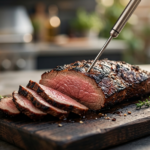
Find where the grain shifts, cut the tri-tip in half at that point, and then slice each half against its own grain. Thin slices, about a quarter inch thick. A perfectly cooked tri-tip sliced wrong will taste worse than a slightly overcooked one sliced right. For more on how doneness works across different steak cuts, this steak doneness guide covers the full range.
FAQ
What temp is tri tip done according to the USDA?
The USDA recommends 145°F with a 3-minute rest for all whole cuts of beef, which lands you at medium. That said, most cooks and chefs consider 130–135°F (medium rare) the ideal tri tip cooking temperature for flavor and tenderness. The USDA guideline is a safety baseline, not a culinary recommendation.
Can I cook tri-tip to well done?
You can, but it won’t be great. Tri-tip is a lean cut with moderate marbling. Past 150°F, the muscle fibers squeeze out most of their moisture and the meat turns dry and chewy. If someone at your table insists on well done, slice them a piece from the thin end — it’ll naturally be more cooked without you having to overcook the entire roast.
How do I know tri-tip is done without a thermometer?
The finger test works in a pinch. Press the thickest part of the tri-tip with your finger. If it feels soft and squishy like the fleshy part of your palm below your thumb when your hand is relaxed, it’s rare. If it feels springy with a little give, like pressing that same spot when your thumb touches your middle finger, it’s around medium rare. Firm with minimal give means medium or beyond. That said, an instant-read thermometer is cheap and far more reliable, especially for a cut this uneven.
Does the tri tip internal temp differ for reverse sear?
The target final temperatures stay the same, but your pull temp changes. For a reverse sear, you smoke or oven-roast the tri-tip at low heat until the internal temperature is about 10–15°F below your target, then sear it over screaming hot heat for 60–90 seconds per side. The sear adds a few more degrees of carryover, so pull at around 115–120°F for medium rare if you’re finishing with a hard sear.
The single biggest mistake people make with tri-tip is treating it like a uniform steak and cooking to the final number instead of the pull number. Grab a thermometer, aim 5–10°F below your target, let it rest, and slice against the grain. That’s genuinely all it takes to nail this cut every time.
If you’re working with a similar lean cut and wondering about temps, the flank steak done temperature guide follows a similar logic with a few of its own quirks.