There is a moment at every Louisiana crawfish boil when the cook lifts the basket, lets it drain, and dumps the whole steaming pile straight onto a newspaper-covered table. No plates, no ceremony. Just a mountain of bright red crawfish, corn, potatoes and sausage, and a crowd that closes in before the steam has even cleared. It feels timeless, like something Louisianans have done forever. The truth is younger and stranger than that. The crawfish boil as we know it is barely a few generations old, and for most of its history, the crawfish itself was an embarrassment — something poor people ate when there was nothing else.
Long before the boil
Crawfish were swimming in Louisiana’s bayous, swamps and ditches for thousands of years before anyone thought of them as dinner. Native peoples knew them well. The Houma tribe held the crawfish as a symbol of courage and honor — their name for themselves is often translated as “red,” and the red crawfish was their war emblem. Tribes caught crawfish with baited reeds and simple traps, and crawfish showed up in local diets long before Europeans arrived, though nobody was building a festival around them.
The turning point came in the mid-1700s, when the British expelled the French-speaking Acadians from their homes in what is now Nova Scotia. Thousands were deported in the upheaval remembered as le Grand Dérangement, and many eventually made their way to south Louisiana, where they became the Cajuns. They arrived knowing how to boil the lobsters and shellfish of the cold North Atlantic. What they found in Louisiana was a miniature freshwater cousin of the lobster, living in mud.
Cajun folklore has its own explanation for the size difference. As the story goes, the lobsters were so loyal to the Acadians that they followed them south, molting and shrinking from the hardship of the journey until, by the time they reached the bayous, they had become crawfish. It is a legend, not history — but it says something true about how completely the little crustacean became part of the Cajun story.
Poverty food and Lenten Fridays
For roughly two centuries, crawfish sat near the bottom of Louisiana’s food hierarchy. Wealthy Creole families in New Orleans might enjoy an elegant crawfish bisque, but out in the countryside, boiled crawfish carried a stigma. They were flood food — gathered when high water stranded them on land and there was little else to eat — or bait. During the Depression, crawfish sometimes sold for a few cents a pound, and government relief workers who tried to promote them as cheap protein found few takers.
One institution kept boiled crawfish on the table: the Catholic Church. South Louisiana was deeply Catholic, and during Lent, when meat was off the menu on Fridays, crawfish were an acceptable, abundant substitute. Many Cajun families ate boiled crawfish mainly in that season, at home, without making a fuss about it. The big public boil had not been born yet, but the habit of gathering around a pot of them had.
Étouffée, back rooms, and the first menus
Crawfish began their climb in the 1920s, in Breaux Bridge, a small town in the heart of Cajun country. At the old Hebert Hotel there, Mrs. Charles Hebert and her daughters cooked up a new dish — crawfish tails smothered in a rich sauce of crawfish fat, onion and cayenne, served over rice. A friend who later served it at her own café gave it the name that stuck: étouffée, French for “smothered.” Restaurants around Breaux Bridge and nearby Henderson started putting crawfish on their menus, sometimes in small private dining rooms where respectable folks could eat them without being seen enjoying something so lowly.
Then came 1959. To mark the town’s centennial, the Louisiana legislature officially declared Breaux Bridge the “Crawfish Capital of the World,” and the town threw a festival the following year. The Breaux Bridge Crawfish Festival did something no amount of home cooking could: it made crawfish respectable, even glamorous. Restaurants across the region followed, prices climbed, and the crustacean’s reputation never went back.
Farming the mudbug
Wild crawfish from the Atchafalaya Basin could never meet the new demand on their own, so Louisiana farmers built an industry. In the 1950s and 1960s, researchers and rice farmers worked out an elegant rotation: after the rice harvest, fields are flooded, crawfish are stocked, and the flooded field becomes a crawfish pond through the winter and spring. The crawfish burrow through the summer while the next rice crop grows above them. Today roughly 70 percent of Louisiana’s farmed crawfish come out of that rice-field rotation, and the state produces an estimated 90 percent or more of all the crawfish eaten in the United States.
The honors kept coming. In 1983, Louisiana named the crawfish its official state crustacean — the first state in the country to give a crustacean that title. And in the 1980s, chef Paul Prudhomme carried Cajun cooking to a national audience, and suddenly the crawfish boil was a backyard ritual from Houston to Atlanta, not just in Acadiana.
The modern boil
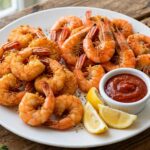
A contemporary boil is simple in outline and fiercely debated in detail. Live crawfish are purged, then tipped into a rolling boil of water seasoned with cayenne, salt, garlic, onions and lemons. Corn on the cob, small red potatoes, whole heads of garlic and smoked sausage go in around them. Seasoning blends are family secrets; arguments about soaking times can end friendships. Crawfish are done when they turn bright red and pull away from the water — a mercy, since judging doneness in most seafood takes more guesswork, as anyone who has used our guide on how to know when cod is done can tell you.
The season runs from late winter into early summer and peaks between March and May, right through Lent and Mardi Gras season — the same religious calendar that kept boiled crawfish alive in leaner centuries. A sack of live crawfish runs about 30 to 35 pounds, and a serious eater puts away two or three pounds of whole crawfish in a sitting. Whatever survives the table goes into étouffée, bisque or the fridge — and if you’re holding leftovers, the storage rules for boiled crawfish are the same ones we lay out for how long salmon lasts in the fridge: a couple of days, sealed cold, no exceptions.
That’s the real history of the boil: a survival food, hidden in back rooms and Lenten kitchens, rescued by a festival and a farming innovation, and turned into Louisiana’s great excuse to stand around a table with people you love. At Ombu Buffet, our Cajun seafood spread owes its existence to that story — every pile of boiled crawfish on the line is a piece of Louisiana history that very nearly didn’t survive.


3 thoughts on “The History of the Louisiana Crawfish Boil”