Walk up to the Fresh Boiled Seafood station at Ombu Buffet in Marrero and you will find two kinds of crab waiting in the steam trays: long, slender snow crab legs and the thick, spiky legs of king crab. They look related — and they are — but they eat very differently, and at a buffet, where you can go back as many times as you like, knowing which is which changes how you build your plate.
Both crabs come out of cold northern water, both are served boiled and ready to crack, and both taste sweet. The differences are in the size of the legs, the texture of the meat, how hard the shell fights back, and what all of that costs the restaurant — which is why one of them shows up in far greater numbers on any buffet line.
How to Tell Them Apart at a Glance
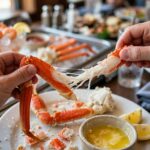
The easiest tell is the legs themselves. Snow crab legs are long and thin, almost elegant, with smooth shells that taper to a fine point. A snow crab cluster — several legs joined at a knuckle — fans out like a hand, and one cluster is about the size of a dinner plate. King crab legs are the opposite: short, thick, and armored, with a shell covered in sharp spines. A single king crab leg can be as thick as your wrist and nearly as long as your forearm, and a red king crab can stretch five or six feet from claw to claw, weighing up to twenty pounds.
Color helps too. Snow crab shells are a warm orange-red when cooked, with a paler underside. King crab shells run a deeper red, sometimes with a brownish-purple cast, and the spines make them impossible to mistake once you have handled one. If the leg in your tongs looks like it could hurt you, that is king crab.
What the Meat Is Like
Snow crab meat is sweet, mild, and a little briny, with a clean finish that does not linger. It pulls apart in thin, fibrous strands — think of it as the shredded texture of pulled pork, but delicate and oceanic. That lightness is why snow crab works so well in salads, pastas, and crab cakes, and why it is so easy to eat a lot of it at a buffet without feeling weighed down.
King crab meat is a different experience. It comes off the shell in big, firm chunks that hold their shape, with a rich, buttery sweetness that most people compare to lobster. It is more intensely flavored than snow crab and more substantial in the mouth — one good king crab leg can feel like a course on its own. Where snow crab invites you to keep picking, king crab announces itself.
Neither is objectively better. Snow crab wins on sweetness and delicacy; king crab wins on richness and the sheer satisfaction of a thick piece of meat. Your mood decides. If you want something light that you can eat alongside the rest of the buffet, snow crab is the call. If you came for one memorable bite and want it to count, king crab is the one to chase.
Why the Price Gap Is So Wide
King crab costs dramatically more than snow crab, and the gap shows up everywhere from the fish market to the buffet tray. In 2026, retail prices for red king crab typically run about $60 to $90 a pound, while snow crab usually sells for around $20 to $35 a pound. Those are general market prices, not Ombu’s — at a buffet you pay one price for the whole line — but they explain a lot about what you see on the trays.
The reasons stack up. King crab is harvested in the Bering Sea under strict quotas managed by NOAA, with a short fall and winter season and some of the roughest fishing conditions in the world. Snow crab, by contrast, is harvested across the North Atlantic and North Pacific from late fall into early summer, in far larger volumes, and it is available for much more of the year. More supply, a longer season, and a smaller animal add up to a lower price.
There is also the question of yield. A king crab leg is mostly meat; a snow crab leg is a lot of shell wrapped around a thinner column of it. One large king crab leg can hold as much edible meat as an entire cluster of snow crab. So even before you count the cost of the catch, king crab delivers more food per leg — and the market charges for it.
Why Buffets Lean on Snow Crab
Put yourself in the restaurant’s shoes. A buffet has to keep the line full, the food hot, and the price fixed — at Ombu, lunch is $13.99 and dinner is $29.99, drinks included. King crab at market prices would eat that margin alive if every guest loaded up on it, so it appears in smaller quantities, as a feature rather than the foundation. Snow crab, affordable and abundant, can be piled high in the steam trays all evening without breaking the model.
Snow crab is also simply friendlier to a buffet setting. The thin shells crack by hand, the meat slides out cleanly, and a cluster is easy to portion — you take one, eat it, and go back for another. King crab needs a cracker or kitchen shears, and its spiny shell is not something you want to wrestle with while balancing a plate in a crowded line. Snow crab keeps the line moving; king crab slows it down.
None of that makes king crab a rare sighting. When it is on the line, take some — that is the point of a buffet. But if you arrive and the king crab tray is empty while the snow crab tray is full, you are not being shortchanged. The snow crab is the workhorse of the seafood station, and it is there in quantity precisely so nobody goes hungry waiting for the premium tray to be refilled.
Which One Should You Eat First?
At a buffet, the order matters more than people think. Start with the snow crab. It is light, it is easy, and it lets you get a feel for the line while the king crab tray is at its fullest. Eat a cluster, decide how you feel about the sweetness, and then go back for the king crab while you still have appetite and patience for cracking it.
That pacing also fits the rest of the meal. The same logic behind what to eat first at a buffet applies here: the delicate things first, the rich things second, and nothing so heavy early on that the rest of the line loses its appeal. King crab is rich enough that two or three legs can be a meal in themselves; save them for the moment you are ready to slow down and enjoy them.
And keep an eye on the time. The seafood station is at its best when the trays are turning over quickly, which is usually early in the dinner service — as covered in our guide to buffet timing, the line peaks when the kitchen is in full swing. A freshly refilled tray of snow crab, still steaming, beats a tray that has been sitting for an hour, whichever crab you choose.
A Few Things Worth Knowing Before You Load Your Plate
Both crabs arrive at the buffet already cooked — crab legs are almost always sold pre-cooked and frozen, then reheated — so what you are tasting is the quality of the reheat, not a raw cook. Good snow crab meat should be white and firm, pulling out of the shell in clean strands. If it comes out mushy or falls apart into shreds, the tray has been sitting too long or was overheated; move on to another station and come back after the next refill.
Butter is the classic partner, and at Ombu the draw is simple: a small dish of melted butter, a squeeze of lemon, and nothing else competing with the crab. Lemon brightens snow crab’s sweetness nicely, while king crab’s richness can stand on its own with barely a dip. Resist the urge to drown either one in cocktail sauce — you will lose the very flavor that makes each crab worth eating.
The Short Version
Snow crab is the long, slender, easy-cracking crab with sweet, delicate, stringy meat — affordable, abundant, and the reason the buffet line can stay full all night. King crab is the thick, spiny, dramatic one, with firm, buttery chunks and a price tag that keeps it in smaller supply. Eat the snow crab first, take the king crab when you see it fresh, and let the butter and lemon do the talking. At Ombu Buffet, 5990 Lapalco Blvd in Marrero, both are on the dinner line — lunch $13.99, dinner $29.99 with drinks included, Monday through Friday 11:30 AM to 9:30 PM and Saturday 11:00 AM to 9:30 PM, closed Sundays. For the hands-on part, see our guide to cracking and eating boiled snow crab legs.