Say his name in a New Orleans bar and somebody will buy you a drink. Say it in a seafood joint and somebody will point at a dish on the menu. Jean Lafitte — pirate, smuggler, privateer, war hero, depending on who is telling the story and how many hurricanes they’ve poured you — is the single most delicious character in Louisiana history. He robbed Spanish ships in the Gulf, ran a black-market empire out of a swamp south of the city, helped Andrew Jackson save New Orleans from the British, and then vanished into the fog of history so completely that nobody knows where or how he died. And two hundred years later, his name still hangs over the food and drink of South Louisiana like the Spanish moss on a live oak.
This is the real story behind the legend — and where you can still taste it.
From French Docks to the Bayous
Jean Lafitte was born around 1780, most likely in France — the Texas State Historical Association’s records say Bayonne, other accounts say Biarritz or the French colony of Saint-Domingue in the Caribbean. Even his last name is disputed: he and his older brother Pierre spelled it Laffite, but English-speaking officials wrote it down as Lafitte, and that version stuck to half the map of Louisiana.
What isn’t disputed is what the brothers built. By 1805 Jean was running a New Orleans warehouse that moved goods his brother’s ships brought in quietly. Then, in 1807, the United States passed the Embargo Act, choking off legal trade with Britain and France — and for men who knew every back channel of the Gulf, it was the opportunity of a lifetime. The Lafittes moved their base to an island in Barataria Bay, a maze of swamps and bayous south of New Orleans that the customs men could never hope to patrol.
By 1810, Barataria was a full-scale operation: a smuggler’s port with its own captains, its own economy, and its own rules. Stolen and contraband cargo — cloth, wine, guns, and, to the shame of the story, enslaved people — came up through the bayous to New Orleans merchants who were happy to pay cash and ask no questions about import duties. Lafitte called himself a privateer, a pirate licensed by a government to raid enemy ships; he carried commissions, at various times, from the revolutionary governments of Cartagena and Mexico. In practice, his crews were less particular about paperwork than about profit.
Barataria Bay: The Smuggling Empire
Life at Barataria was organized like a business, not a cartoon. The Lafittes held shares in privateers sailing the Gulf and Caribbean, and the prizes were brought back to the bay to be broken down, appraised, and moved to market. The enterprise employed hundreds of men — sailors, carpenters, blacksmiths, pilots who knew the passes through the marsh the way you know the rooms of your own house. Governor William C. C. Claiborne tried to shut it down and failed repeatedly; the swamp swallowed every expedition sent into it.
The food that fed this floating economy came straight out of the same waters the smugglers sailed. Shrimp, oysters, redfish, crabs — the working catch of Barataria Bay, cooked the way working people in Louisiana have always cooked it: simply, over fire, with whatever seasoning was at hand. It’s the same coastal pantry that later made its way into the great Louisiana seafood traditions, including the crawfish boil, whose own winding history runs through these same bayous.
The Deal That Made Him a Hero
In September 1814, everything changed twice. First, a United States naval force finally raided Barataria and seized most of Lafitte’s fleet. Then the British arrived off the Gulf Coast with an offer: money, land, and a commission in the Royal Navy if the Baratarians would help them take New Orleans.
Lafitte said no — and then handed the British plans, and his own services, to the Americans. The price he named was a pardon for his men. General Andrew Jackson, preparing to defend the city with a patched-together army, accepted. Lafitte’s crews brought what Jackson’s army desperately lacked: flints, gunpowder, artillery, and men who knew the ground around New Orleans better than anyone alive.
On January 8, 1815, at the Battle of New Orleans, the Baratarians fought alongside Jackson’s regulars, militia, and volunteers — and helped deliver one of the most lopsided American victories of the war. President James Madison pardoned Lafitte and his men in 1815. The pirate had become a patriot, at least on paper. The Lafittes spent the winter of 1815–16 in Washington and Philadelphia trying to get their confiscated property back; they came home empty-handed, which tells you everything about how much gratitude governments keep in reserve.
Campeche and the Vanishing Act
A pardon didn’t reform Jean Lafitte; it just moved him. In 1817 he established a new colony on Galveston Island — then part of Spanish Texas, effectively beyond anyone’s law — and called it Campeche. From a fortified headquarters known as the Maison Rouge, the Red House, he ran an operation bigger than Barataria had ever been, with as many as a thousand men and annual takings that ran into the millions in today’s money.
It lasted until it couldn’t. After some of his men attacked American property in 1820, the U.S. Navy came knocking again. Lafitte left Galveston peacefully in 1821 with his closest followers, sailed to Isla Mujeres off the Yucatán coast, and kept at the old trade for a few more years. Then the record goes dark. Some evidence points to a death in Mexico around 1826; other accounts have him dying at sea. Historians still argue about it, which is exactly the ending a man like Lafitte deserves.
Where to Taste the Legend Today
You don’t need a time machine to find him. Start in the French Quarter at Lafitte’s Blacksmith Shop Bar on Bourbon Street, one of the oldest buildings in the Quarter — a low Creole cottage long rumored to have been one of his haunts, and a fine place to sit with a drink and imagine the bayous outside the city walls. Then drive down to the town of Jean Lafitte and the Barataria Preserve of the Jean Lafitte National Historical Park, where the swamp that hid his fleet is still there, still quiet, still full of the same shrimp and crabs and redfish.
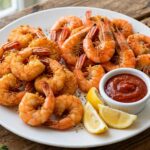
And at the table, his name keeps turning up the way pirate names do — on seafood platters and restaurant walls, in stories swapped over oysters. It’s fitting. The cuisine of coastal Louisiana grew up in the same waters, markets, and back channels as Lafitte’s empire. The smuggler is gone and the swamp keeps his secret, but every time a tray of Gulf shrimp hits the table, you’re eating from the country he once ruled.





1 thought on “Jean Lafitte: Louisiana’s Pirate, Privateer, and Folk Hero”