The Christmas decorations are barely put away when it starts. You walk into a Louisiana grocery store in early January, past the picked-over holiday candy, and there they are — king cakes, stacked in the bakery case in their rings of purple, green, and gold. Nobody asks why they’re out in January. In Louisiana, January 6 has its own name, its own rules, and its own dessert. Twelfth Night opens Carnival season, and from that day until Mardi Gras, the state eats like the calendar is about to take the food away. Which, come Ash Wednesday, it is.
Carnival is traditionally said to come from the Latin carne vale — farewell to meat. Before the Lenten fast, the feast. Mardi Gras, Fat Tuesday, is the farewell party itself: the last day of indulgence before six weeks of abstinence. And Louisiana, having been given centuries to perfect the art of the farewell party, throws the kind of feast that needs its own food traditions, its own season, and its own rules about who buys the next cake.
It All Begins on Twelfth Night
Carnival season always begins on January 6 — Twelfth Night, the Epiphany, twelve days after Christmas, marking the visit of the three Magi to the Christ child. The king cake, the gâteau du roi, was originally served for that feast day, and it still opens Carnival the way it always has: a ring of rich yeast dough, swirled with cinnamon, iced in the carnival colors, with something hidden inside.
The hidden something used to be a bean or a pecan half. These days it’s usually a small plastic baby, and the rule is the social engine of the whole season: whoever finds the baby in their slice buys the next king cake — or hosts the next king cake party. One cake buys another buys another, and that’s how offices, classrooms, and whole neighborhoods end up eating king cake from January 6 straight through to Mardi Gras. (In 2027, that’s a good long run: Twelfth Night on January 6, Fat Tuesday on February 9.)
A few things the out-of-towners miss. The colors mean something: purple for justice, green for faith, gold for power, chosen by the Rex krewe back in 1872 and never changed since. The original cakes were simple, rich yeast dough; modern bakeries fill them with cream cheese, praline, fruit, and a dozen other inventions. And in Louisiana bakeries today, the baby is often tucked outside the cake rather than baked in — a modern caution about choking hazards, not a loss of tradition. The obligation survives just fine either way: find the baby, buy the cake.
Local etiquette says king cake season ends on Fat Tuesday. Eating one after Mardi Gras is considered bad luck — or at least bad form. The window closes at midnight, like everything else in Carnival.
The Kitchen Between Parades
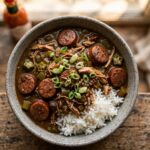
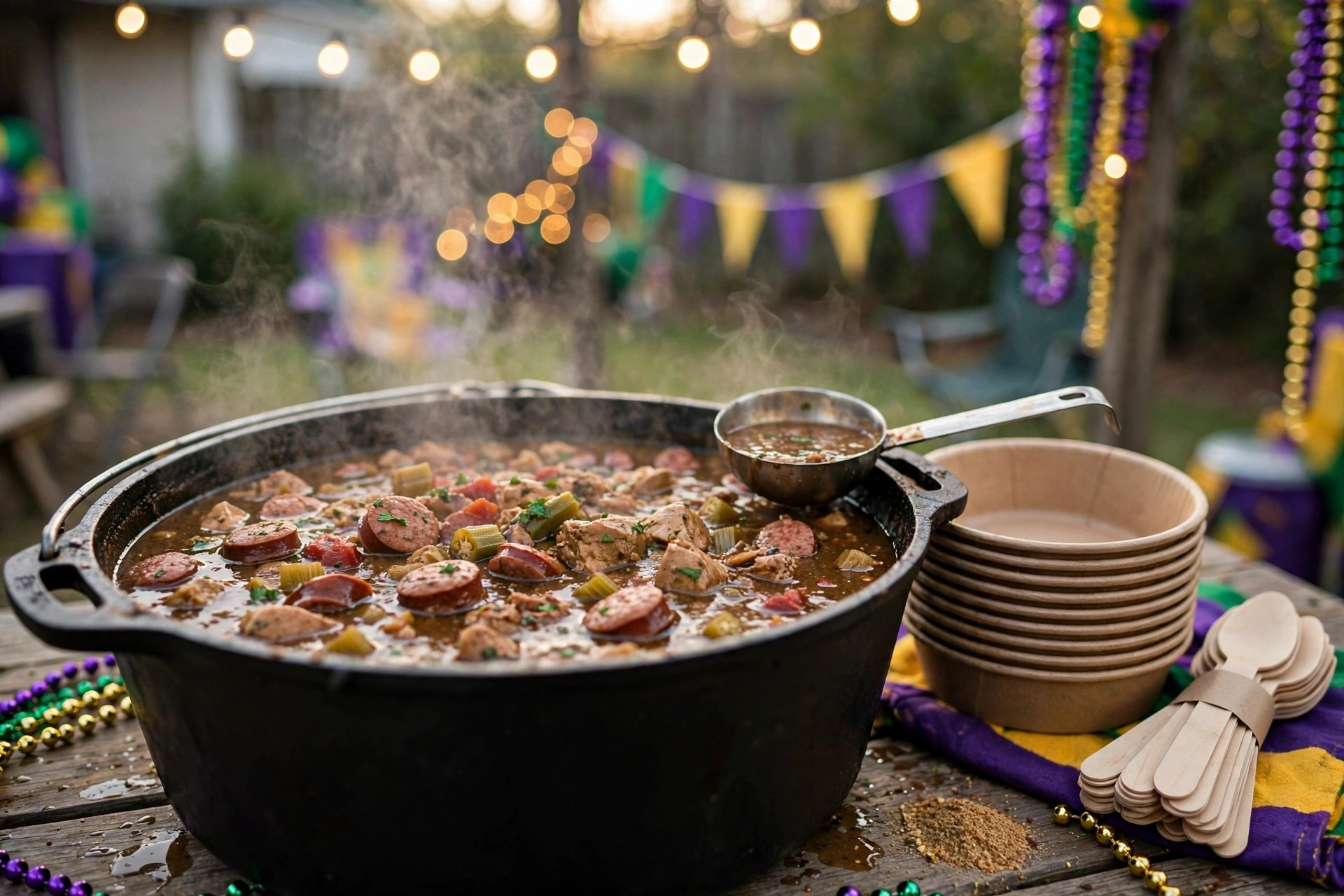
The parades get the television cameras, but the real cooking of Carnival happens in houses — at the parties and balls and tailgates between the parades. This is gumbo weather, and the pots come out early and stay out. A dark chicken-and-sausage gumbo is the backbone of the season: it feeds a crowd, it holds for hours, it tastes like somebody’s grandmother is watching over the roux. Seafood gumbo shows up too, especially closer to the coast, and jambalaya — the one-pot rice dish that can stretch to feed whoever wanders in — is the parade-day workhorse.
Andouille sausage does heavy duty through all of it, in the gumbo and the jambalaya both. It also makes one of the great parade-day sandwiches: grilled andouille tucked into a split loaf of French bread with Creole mustard, eaten standing up with one eye on the float schedule. Po-boys of every kind follow the same logic — food that travels, food you can eat out of your hand while shouting for beads.
That’s the test of a Carnival dish, really: can it survive a party that starts at noon and ends when the band leaves? The dishes that fail the test don’t get made twice. The ones that pass — gumbo, jambalaya, red beans, king cake, fried everything — become traditions by sheer endurance.
Eating Along the Parade Route
Parade day in Louisiana has its own cuisine, and it’s governed by the cooler. Families stake out their spot on the neutral ground — the grassy median the rest of the world calls a median — sometimes the night before, ladders and all. The ladders aren’t for climbing. They’re bleacher seats for the kids, lashed together and decorated, the family’s grandstand for the hours ahead.
Out of the coolers comes the parade spread: fried chicken (one famous New Orleans chain is practically a parade-route institution), po-boys wrapped in foil, chips, pickles, soft drinks for the kids and cold beer for the grown-ups. Some families go full spread — a folding table with real dishes, because this is Louisiana and some things are not negotiable even on a sidewalk.
Food even falls from the sky, in a manner of speaking. Float riders toss “throws” to the crowds shouting “throw me something, mister!” — beads, cups, doubloons — and some of the prized catches are edible. Zulu’s hand-painted coconuts are the holy grail of throws, and MoonPies, those packaged marshmallow sandwiches, get lobbed along the routes by the case. There are ordinances about throwing unwrapped food in some places; the MoonPie, safely wrapped in cellophane, sails through legally. Catching food from a float is not how other states spend their February. Louisiana has never seen a reason to be other states.
The Other Carnival: The Chicken Run
Now leave the city. Drive west into Acadiana, into Cajun country around Eunice, Mamou, and Basile, and you’ll find a Carnival that has nothing to do with floats. On Mardi Gras morning, masked and costumed riders on horseback — the Courir de Mardi Gras, the Mardi Gras run — go from house to house through the countryside, singing for ingredients. They beg for onions, rice, sausage, seasonings. And the prize, the whole point of the chase, is the chicken.
A live chicken is set loose in a field, and the masked runners chase it down — feathers flying, kids screaming, the whole masked capuchon-wearing crew piling on. The caught chickens go into a communal gumbo cooked that afternoon and shared by everyone, riders and watchers alike. It’s a tradition the Acadians carried from medieval France, older than anything on St. Charles Avenue, and it ends the same way the city Carnival does: with a pot of something delicious shared by a crowd that worked up an appetite earning it.
This coastal Carnival runs on legend as much as on chicken. Pirate lore has never really left Louisiana’s bayous — the same waters and back channels show up in the costumes, the floats, and the town signs you pass on the way to the parades. Jean Lafitte, the smuggler who ruled Barataria Bay two hundred years ago, is still the state’s favorite outlaw, and his name hangs over half the seafood platters downriver. We’ve told his whole story here — read it before the parade, and you’ll see the coast differently.
Midnight and Ashes
Every Carnival season ends the same way. At midnight on Fat Tuesday, the police ride down the street behind the last parade and the party is over — not gradually, but officially. The next morning is Ash Wednesday, foreheads marked with ash, and the feasting gives way to the fast. The king cakes disappear from the bakery cases. The gumbo pots get washed. The city, the parishes, the whole state turn the page to Lent and seafood season together.
That’s the genius of the Louisiana calendar, when you step back and look at it. The farewell to meat gets six weeks of feasting, and the six weeks of fasting get the best seafood of the year. Carnival ends, and the next tradition begins — and if you’ve planned it right, you’re never more than a week from something worth gathering around a table for. Laissez les bons temps rouler, yes. But around here, the good times have always come with a menu.