In 2006, an eighth-grader at Vandebilt Catholic High School in Houma did what generations of adults had failed to do: he actually looked at the Louisiana state flag. The pelican on it — the mother bird feeding her chicks, the symbol Louisiana had flown for a century — was missing something. Three drops of blood on her breast, there in the old 19th-century renderings, gone from the modern ones. The boy told his state legislator. The legislator introduced a bill. The bill became law.
That is how Louisiana got its current flag — not by committee of heraldists, but because a thirteen-year-old paid attention. The story of the flag, like the story of the state, is stranger and older than it looks.
A Mother’s Blood, Painted on a Flag
The emblem at the center of Louisiana’s flag has a name out of medieval bestiaries: the pelican in her piety. It shows a mother pelican in a nest, tearing at her own breast to feed her three chicks with her blood — an ancient heraldic image of self-sacrifice. Medieval Christians read it as a symbol of Christ’s Passion and the Eucharist; Louisiana reads it as the state feeding and protecting its people. Look closely at the current design and you’ll notice the mother bird’s head and outspread wings form the shape of a fleur-de-lis, the old emblem of French Louisiana, tucked into the image like a signature.
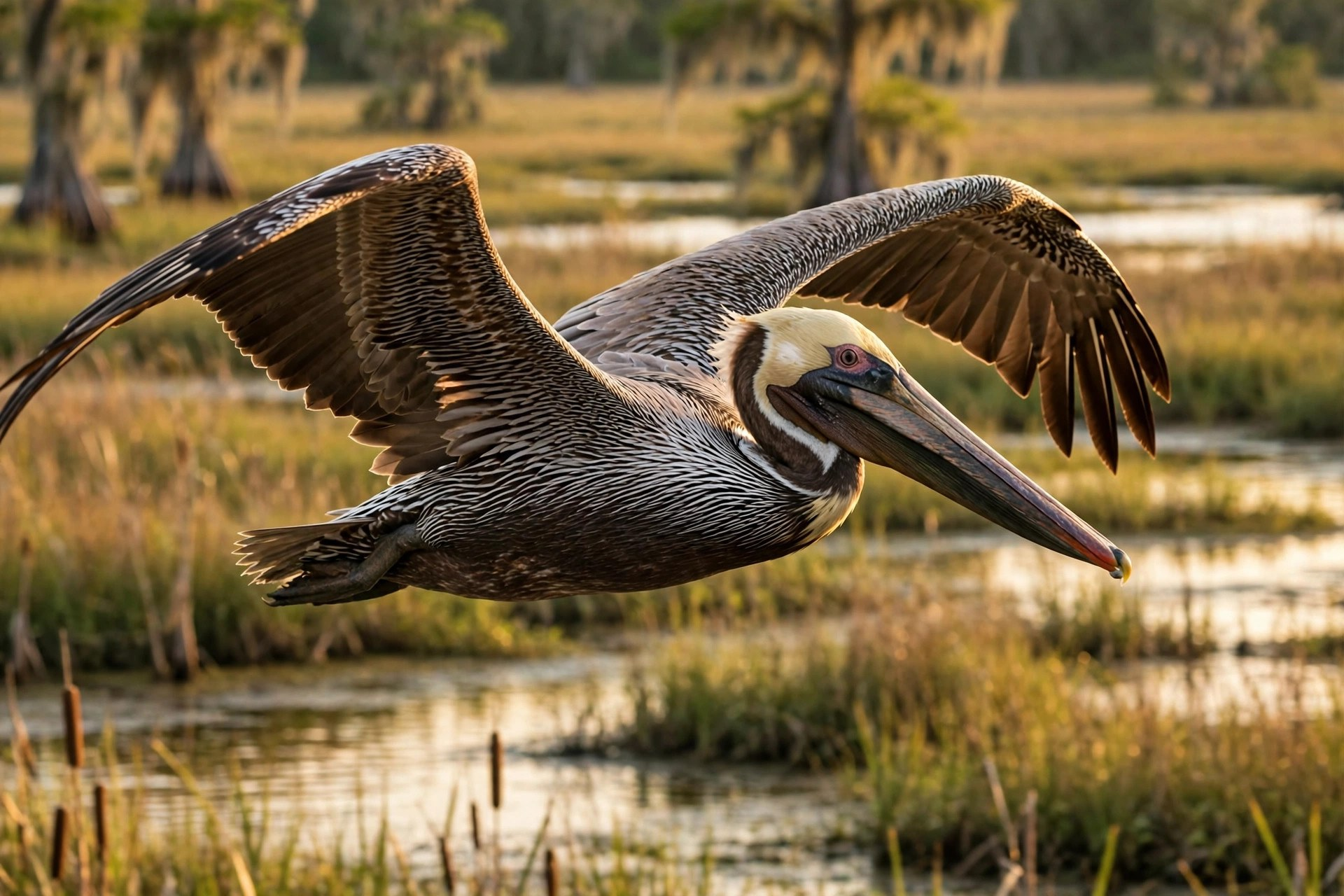
The bird itself is no accident of symbolism. The brown pelican is Louisiana’s state bird, native to its coast, and its diving silhouette is one of the Gulf’s most familiar sights. Beneath the nest runs a white ribbon carrying the state motto: “Union Justice Confidence” — three words with their own Civil War story, which we’ll come to.
From Territory Seal to State Symbol
The pelican entered Louisiana’s official imagery in 1803, when William C. C. Claiborne, the first governor of the Orleans Territory, chose it for the territory’s seal. Through the 19th century the bird showed up on military and civic banners, on the state seal, and — during the Civil War — on flags flown by Louisiana troops. It was traditional in those early renderings for the pelican to carry three drops of blood on her breast.
Here’s the catch: before 1861, Louisiana had no official flag at all. The pelican banners people flew were unofficial. When the state seceded in January 1861, before the Confederacy even existed, Louisianans briefly flew a flag based on the French tricolor with seven stars on its blue stripe, and a pelican design alongside the Confederate flags. The bird was beloved; it just wasn’t law yet.
1912: Louisiana Finally Makes It Official
The legislature got around to it in 1912. The bill described “a solid blue field with the coat of arms of the State, the pelican feeding its young, in white in the center, with a ribbon beneath, also in white, containing in blue the motto of the State, ‘Union, justice and confidence.'” It passed the House 71–1 on June 13 and the Senate 32–0 on June 28.
But the 1912 law said almost nothing about what the pelican should actually look like — not the number of chicks, not the style, not even the shade of blue. So for nearly a century, every flagmaker drew their own version. Some pelicans had the blood drops; many didn’t. Chicks came and went. Nobody’s flag quite matched anybody else’s.
The Boy Who Fixed the Flag
Enter the eighth-grader from Houma. Having learned the traditional design in school, he noticed the blood drops were missing from the flags flying around the state, and he brought it to his legislator. On May 25, 2006, the legislature answered with Act 92 — House Bill 833 — requiring that the pelican on both the flag and the state seal display “an appropriate display of three drops of blood” on her breast.
It’s one of the great small stories in American vexillology: a state symbol corrected by a kid’s homework. But the law set a requirement without supplying a design, and the mismatched pelicans kept flying.
2010: The Flag Gets Its Final Form
On November 22, 2010, Louisiana finally standardized the flag properly. Baton Rouge artist Curtis Vann Jr. was hired to draw the definitive pelican, and he modeled it on a real brown pelican — rendered in white as the 1912 law requires, but with the species’ yellow-brown crown worked in. The new specification set an azure blue field, showed the mother bird “in her vigilance,” the heraldic term for the protective stance, and made one quiet edit to the motto ribbon: the word “and” came out, leaving the motto as it reads today — “Union Justice Confidence.”
That word order, incidentally, is a scar of the Civil War. Before the war, the motto ran “Justice Union and Confidence”; afterward, with union and Reconstruction the order of the day, the state flipped it to “Union Justice Confidence.” The flag is 7 parts tall to 11 wide, and the statute now pins down the crest’s size and colors to the Pantone — a level of precision the 1912 legislators never imagined they’d need.
The Bird That Almost Disappeared
There is a darker chapter the flag doesn’t show. By the mid-20th century, the brown pelican — the living bird behind the symbol — had nearly vanished from Louisiana’s coast, poisoned by the pesticide DDT. The state that called itself the Pelican State watched its namesake disappear. Decades of conservation work, including reintroduction programs, brought the bird back; the brown pelican was removed from the federal endangered species list in 2009. The flag kept flying through all of it, which is perhaps the point of the image: the mother bird endures, and so does the state.
Spotting the Flag — and the Bird — Around Louisiana
Today the flag is everywhere in Louisiana: over the capitol in Baton Rouge, outside schools and courthouses, on t-shirts and restaurant walls, at every festival where state pride runs high. It is one of the most distinctive state flags in the country — no stars-and-stripes knockoff, just a blue field and a mother bird doing what Louisiana has always claimed to do: feed its own.
And the real thing is worth seeing too. Drive the coast road toward Grand Isle or cruise the Barataria waterways and you’ll spot brown pelicans dive-bombing for menhaden, exactly as they did when Claiborne picked the bird two centuries ago. Pair the sighting with a plate of the local catch and you’ve got Louisiana in a day: the symbol on the flagpole, the bird on the wing, and the seafood that ties the whole story together — the same coastal culture that defines what it means to eat, and be, Cajun.