Walk into almost any restaurant in America and “Cajun” on the menu usually means one thing: spicy. Cajun chicken pasta, Cajun fries, Cajun anything, dusted with a red seasoning blend and served with an apology to your sinuses. Real Cajun cooking is something else entirely — older, quieter, and far more specific. It isn’t a spice level. It’s the food of a particular people, shaped by exile, poverty and one of the most generous landscapes in North America. So what actually makes a dish Cajun?
It starts with a people, not a pepper
The word itself gives the game away. “Cajun” is what happened to “Acadian” after generations of Louisiana French wore it down — les Acadiens became les Cadiens, and then, in English mouths, Cajuns. The Acadians were French colonists who had farmed the marshlands of present-day Nova Scotia since the early 1600s. In 1755, during the French and Indian War, the British began deporting them — families separated, farms burned, thousands scattered to colonies, to England, to France. Many eventually found their way to the one place that would have them: French Louisiana.
They didn’t settle in New Orleans. They spread across the prairies, bayous and swamps of southwestern Louisiana — the region now called Acadiana — and built a rural, self-reliant culture that stayed apart from the city for two hundred years. Cajun cooking is what that isolation produced. It is country food, made by farmers, trappers and fishermen from whatever the land and water provided, stretched to feed large families from a single pot.
Cooking from what the land gave
Classic Cajun dishes are one-pot dishes, and that isn’t an accident of style. A farm family with a cast-iron pot, a rice crop and whatever came out of the bayou or the smokehouse needed meals that were filling, forgiving and built in layers. Rice — grown in Louisiana since the early colonial era — became the foundation, the stretcher that turned a little meat into dinner for twelve.
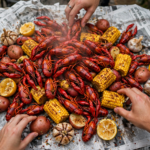
The pantry tells the story: pork in every form, from andouille and tasso to the boudin stuffed at community boucheries where neighbors gathered to butcher a hog and waste none of it. Wild game and duck on the prairies. Crawfish, shrimp and crab near the coast. Very little beef, almost no dairy, and for most of Cajun history, no tomatoes — tomatoes simply weren’t part of the rural Acadian garden tradition the way they were in the city.
The trinity and the roux
Nearly every Cajun dish begins the same two ways. First, the trinity: onion, celery and green bell pepper, roughly diced and cooked down in fat. It’s Louisiana’s answer to French mirepoix, with bell pepper standing in for carrot — and once garlic joins the pot, old cooks joke that the trinity has been joined by the pope. Second, the roux. Flour stirred into oil or lard and cooked slowly, patiently, past blond and peanut butter and copper, all the way to the color of dark chocolate.
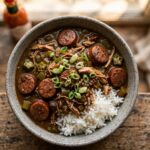
A dark Cajun roux is a commitment. It can take the better part of an hour of constant stirring, and it stops thickening much — what it gains instead is depth, a toasted, almost smoky foundation that makes a gumbo taste like itself. From that base, a gumbo spends hours at the barest bubble; if you want to know what that patience looks like in degrees, our breakdown of simmer temperature on the stove is the same gentle heat a gumbo lives at. Filé powder — ground sassafras leaves, borrowed from the Choctaw — goes in at the table, never boiled, thickening and perfuming each bowl. Gumbo itself carries the blending in its name, most likely from a West African word for okra, a reminder that enslaved African cooks shaped this food as surely as French technique did.
Cajun is not Creole
The fastest way to start an argument in Louisiana is to confuse the two cuisines, so here is the short version. Creole cooking belongs to New Orleans: urban, older, built by French and Spanish colonists, enslaved Africans, free people of color and Caribbean traders, with access to imported goods, butter, cream — and tomatoes. Cajun cooking is its country cousin, developed a generation later out in Acadiana, with oil-based roux, no tomatoes, and ingredients that walked, swam or grew within a few miles of the pot.
You can taste the difference in the two jambalayas. A Creole jambalaya is red, cooked with tomatoes in the New Orleans style. A Cajun jambalaya is brown — the rice gets its color from meat browned hard in the pot and a dark, patient cooking process, and a traditionalist would sooner leave the kitchen than open a can of tomatoes near it. Neither is better. They’re records of two different Louisianas.
And no, it isn’t really about the heat
Here’s the part the seasoning-blend version gets wrong. Traditional Cajun food is deeply seasoned — salt, black pepper, cayenne, garlic — but it aims for balance, not punishment. The blow-your-head-off image is a 1980s invention, from the years when chef Paul Prudhomme’s cooking swept the country and “Cajun” became a national marketing craze. Even blackened fish, the dish that defined the era, was Prudhomme’s own 1970s creation — delicious, famous, and not a traditional Cajun technique at all. Done the classic way, a blackened fillet still has to be cooked through properly, which is why the doneness temperature for fish like tilapia matters more than the crust of spices on the outside.
So what makes it Cajun? A people who refused to disappear. A pot built on trinity and dark roux. Rice to stretch it, pork to enrich it, the bayou to fill it, and seasoning with a firm hand and a sense of proportion. It’s the cooking of Acadiana — and once you’ve had the real thing, the red dust on airport fries never quite passes for it again. At Ombu Buffet, that’s the standard our Cajun side of the line is held to: country food, cooked patiently, seasoned like somebody’s grandmother is watching.


3 thoughts on “What Makes It Cajun?”