There’s an old saying among Gulf shrimpers about what goes in the cooler when the boat leaves the dock. The point of it is simple: out there, you don’t need fancy. You need food that keeps, a crew you trust, and a tide you can read. Life aboard a Louisiana shrimp boat has never been glamorous. That was never the point. The point was freedom — your own boat, your own hours, and a living pulled straight out of the water with your own hands.
Louisiana has led the nation in shrimp landings most years since 2000, averaging around forty percent of the entire Gulf catch for more than half a century. Behind every pound of it is someone like the people in this story. This is a day in their life.
Four in the Morning
The day starts before the day does. Somewhere around 4 a.m., in a bayou town like Dulac or Delcambre or Empire, a shrimper is already awake, checking the tide tables and the weather radio over coffee strong enough to stand a spoon in. The big boats — the offshore trawlers — don’t come home every night. A crew might stay out a week or two at a time, sleeping in bunks below deck, working the nets around the clock in shifts. One fourth-generation shrimper out of Houma told the Los Angeles Times he routinely brings in more than 30,000 pounds on a two-week trip aboard his 63-foot boat. The shrimp were never the problem, he said. The problem was getting paid for them.
But that’s later. First there’s the leaving: easing out of the canal in the dark, running lights on, the marsh sliding past on both sides. By sunrise the boat is on the fishing grounds, and the first drag of the day goes over the stern.
The Work of a Drag
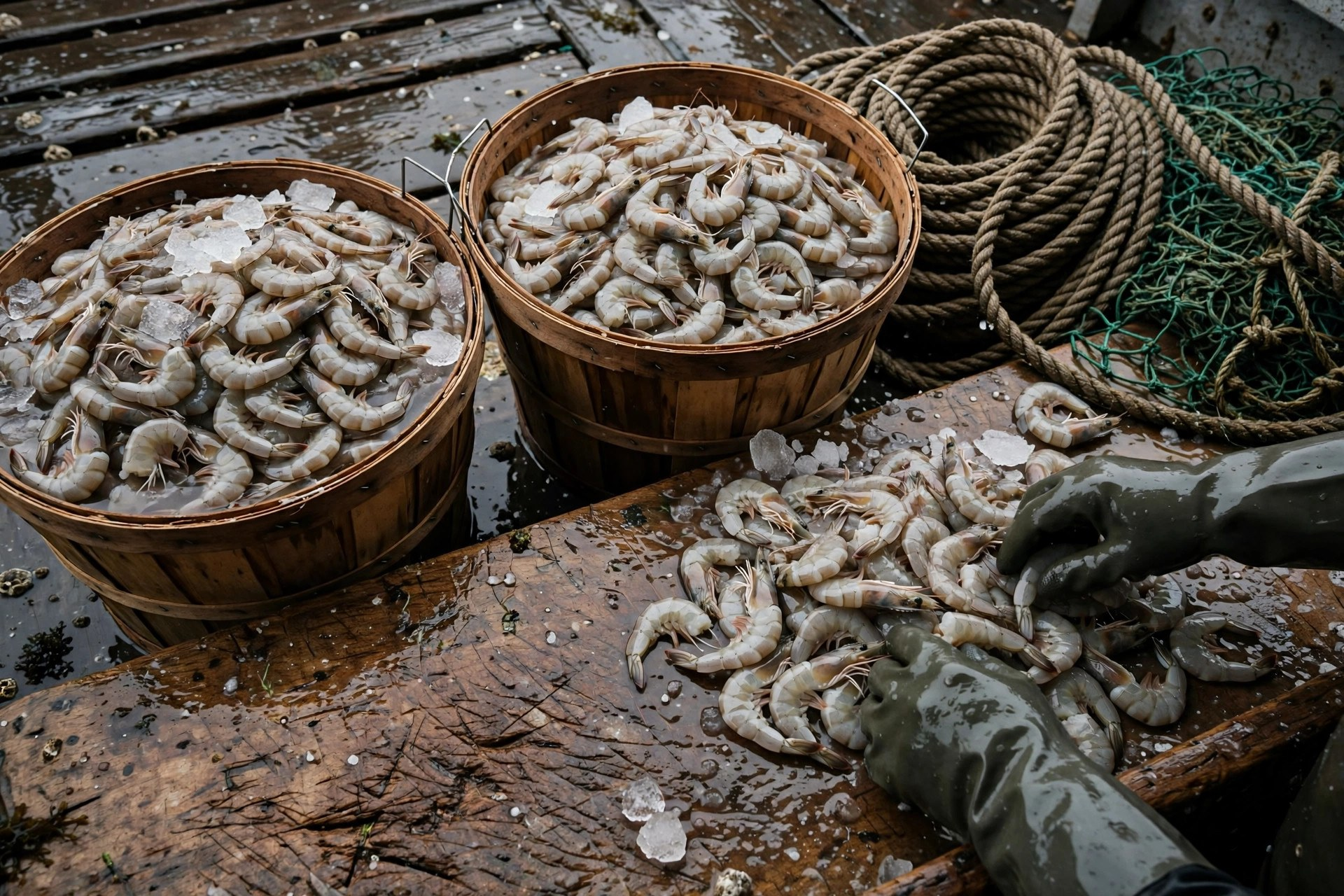
A shrimp trawl is not delicate work. The nets go down and the boat drags them slowly across the bottom, and then comes the part that breaks backs: the winch hauls everything up, the catch gets dumped into bushel baskets, the baskets get lifted onto the culling table, and the crew sorts shrimp from bycatch by hand — crabs, small fish, the occasional surprise — before the keepers go into the hold on ice. Then the nets go back down, the deck gets swabbed, the machinery gets checked, the rope gets coiled. Then it all happens again.
The nets are fitted with turtle excluder devices, required by law for decades now, and the bycatch gets tossed back. A good crew moves like a machine that has been oiled by repetition, because it has. Everything on deck has a place and a rhythm, and the rhythm doesn’t stop because it’s hot, or because the seas kicked up, or because it’s 2 a.m. and the last drag still isn’t sorted. You eat when there’s a gap. The gap is never long.
The Boat Is a Home
What surprises people who’ve never been out is how small the world gets. A shrimper might spend two weeks with one or two other human beings, and the social life of the whole Gulf fishery runs over the VHF radio — captains checking in with each other, sharing where the shrimp are running, and every one of them with a nickname the whole fleet knows. It’s a close-knit community spread across a very large, very empty body of water.
The galley cooking is the stuff of legend in its own way: potted meat and crackers, canned whatever, and — the great perk of the job — shrimp and crab and speckled trout caught by hand, boiled on deck and eaten standing up. Nobody out there is eating baloney on white bread. The food is whatever’s simple and whatever’s fresh, and the fresh part is the best seafood in America, pulled from the water an hour ago.
And there’s the other thing the old-timers talk about, the part that doesn’t show up in the economics: the beauty of it. The sun coming up over the marsh, dolphins working the wake, the particular quiet of a boat idling on open water at night. Men who could have done anything else — and plenty of their kids have — will tell you they wouldn’t trade it. The work is hard, the money is uncertain, and the freedom is absolute.
Two Seasons, Two Shrimps
Louisiana shrimping runs on a calendar as old as the coast. The spring season typically opens in May — brown shrimp, the early crop — and the fall brings the white shrimp run, the big harvest that fills the freezers before winter. (If you’ve read our piece on Louisiana’s seafood seasons, you know May shrimp arrives like a reward the calendar arranged.) Shrimp live fast and die young — about an eighteen-month life cycle — which makes them resilient. A bad year doesn’t end the species. It just ends somebody’s year.
Summer brings its own trouble: the dead zone, the stretch of low-oxygen water that blooms off the coast each year and pushes shrimp out of their usual grounds, forcing boats to run farther and burn more fuel to find them. Every season has its tax. The shrimpers pay it and go back out.
The Price Squeeze
Here’s the part that keeps the fleet shrinking. The Gulf can be full of shrimp and a shrimper can still barely make a living, because the price at the dock has been crushed by imports — farmed shrimp from India, Ecuador, Vietnam, and Indonesia, arriving by the billions of pounds. In recent years, wild-caught Gulf shrimp has sold at the dock for under a dollar a pound in the worst stretches. That Houma shrimper with the 30,000-pound trips put it plainly: catching the shrimp was never the problem. Making a profit was.
The math is brutal and specific. One Port Sulphur shrimper spent $7,000 just getting his boat out of dry dock for the season, then pulled a 4,000-pound haul that fetched eighty cents a pound at the wholesale dock in Buras — and after fuel and ice, could pay his son and grandsons $150 apiece. Another, in Berwick, retrofitted his boat with an $18,000 electric cooler just to escape the ice-house squeeze and sell his catch dockside, direct to customers, at three-fifty to five dollars a pound. “It keeps them just before freezing,” he said. “You get beautiful shrimp.”
And then there’s the line that says it all, from a Grand Isle seafood buyer watching the whole thing happen: “If the daddy don’t show the son no more, it’s broken.” The knowledge — reading water, mending nets, knowing where shrimp run in a west wind — passes from parent to child or it dies. Increasingly, the fathers are telling the sons to learn welding instead.
Blessing of the Fleet
And yet the culture holds. Every August, the town of Delcambre — which has hosted its Shrimp Festival since 1950 — closes the celebration with a Fisherman’s Mass and the Blessing of the Fleet, the priest standing dockside flicking holy water over the bows as the trawlers pass. Over in Morgan City, the Shrimp and Petroleum Festival runs every Labor Day weekend, a tradition that started with the first blessing of the fleet in Berwick Bay back in 1937, when the whole thing was simply called the Shrimp Festival.
These aren’t tourist pageants, though tourists are welcome. They’re a working community asking for protection and a good season, the same way their grandparents did. The cook-offs, the boat parades, the fais-do-dos — it all rests on the same foundation as the work itself: that the boats go out, and that they come back full.
What It Means on Your Plate
So what does any of this have to do with dinner? Everything. The shrimp on a Louisiana table didn’t fall out of the sky. Somebody woke up at 4 a.m., ran a boat through the dark, dragged a net, sorted the catch by hand, and iced it down — and then sold it for less than the cost of the fuel it took to catch it. When you buy Gulf shrimp, when you ask where your shrimp came from, when you choose the wild-caught Louisiana shrimp over the anonymous imported bag, you’re voting on whether that way of life survives.
Wild Gulf shrimp tastes like where it lived — briny, sweet, with a snap that farmed shrimp, raised on pellets in a pond, can’t quite imitate. Louisiana cooks have always known the difference. Now you know the story behind it, too.
At Ombu Buffet, the shrimp on our line comes from this world — the boats, the bayous, the 4 a.m. departures. Every plate of it carries a little of that salt air and stubbornness. Come taste what the fleet brought home.



1 thought on “No Baloney on My Boat: Life of a Louisiana Shrimper”