The first morning at Tsukiji is all appetite. You arrive hungry, you eat small things from six stalls, you leave dazed and full and certain you missed half of it. The second morning is the one that stays with you — because once the hunger stops making the decisions, you start noticing everything the hunger skipped. The return visit is not about eating more. It is about seeing the place for what it is: a working culture that happens to feed you, not a food hall that happens to have history.
So go back. A second morning at the market is a different education, and it costs nothing extra.
The Second Morning Is for Watching
On the first visit you watch the food. On the second, you watch the hands. The vendor carving thick slabs off a bluefin laid open on his counter does it with the calm of a man who has done it ten thousand times — no ceremony, no audience-awareness, just a knife moving the way it has always moved. The tamagoyaki cook folds layer over layer on a grill the size of a door and never looks down. Even the way the fishmongers stack ice is a technique, tight and practiced, the kind of craft that only looks effortless because it never stops.
This is the thing the grazing visit misses: Tsukiji is a craft district disguised as a food court. The knife shops in the outer market sell blades forged in traditions that trace back to swordsmithing — chefs come from all over Japan to have their knives made, sharpened, and named here. A good yanagiba, the long single-bevel blade for slicing sashimi, is an object of genuine beauty, and the shopkeepers will talk steel with you for half an hour if you let them. The first visit is for the fish. The second is for the tools that cut it.
The Stalls That Aren’t About Fish
Here is what you walk past when you are single-mindedly hunting seafood: the fruit. Japanese fruit is treated as a luxury rather than a commodity, and the market’s fruit stands sell strawberries like jewels and melon by the cup, cut with surgical precision. The watermelon juice from the juice bars — cold, sweet, nothing like the bottled kind — is one of the best things in the whole market, and most first-timers never touch it because they are saving room for tuna. That is a mistake worth correcting on visit two.
Then there is the wagyu. Menchi-katsu — a deep-fried minced beef cutlet with a panko crust — made with marbled Japanese black beef, crispy outside and impossibly juicy within. Wine stands doing wagyu skewers and a glass of wine at nine in the morning, which is either decadent or perfectly logical depending on how the first visit went. The market’s non-fish stalls are the tell: a place this confident about seafood doesn’t feel threatened by a beef cutlet. It just feeds you whatever is good.
One Street, Four Centuries
The return visit is also when the history starts reading like a novel. The name itself is the first clue: Tsukiji literally means “reclaimed land.” After the great fire of 1657 leveled much of Tokyo, the shogunate shoveled earth into the bay to make new ground, and the district that rose on it was samurai estates and temples — not a fish market at all. The fish came from Nihonbashi, where a market had grown up back in the Edo period to feed the shogun’s castle. Then the Great Kanto Earthquake of 1923 flattened Nihonbashi, and the market relocated to Tsukiji in 1935 as a “temporary” solution that lasted 83 years.
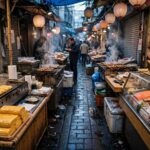
You can still feel those layers in the outer market’s lanes: the old-Tokyo downtown townscape, the shrines tucked between stalls, the shops selling kitchenware and dried goods and pickles alongside the sushi bars. The 2018 move to Toyosu was only the latest chapter. The outer market didn’t just survive the wholesale floor’s departure — by most accounts it leaned harder into being a food destination once the trucks stopped rumbling through. Four centuries of reinvention, and the current version might be the tastiest.
The Auction You Watch, the Breakfast You Eat
On a second trip, the two markets start to make sense as a pair rather than a puzzle. Toyosu is where the spectacle lives now: the dawn tuna auction, running roughly 5:30 to 6:30 on weekday mornings, watched from a free observation gallery above the floor — or, for the determined, from a lower deck so close you can hear the bidding, admitted by lottery at a hundred people a day. It is electrifying and it is at five in the morning, which is its own kind of commitment.
But the breakfast belongs to Tsukiji. That is the division of labor the city has settled into, and honestly it is the better deal for a diner: let the auction be the theater at Toyosu, then come back to Tsukiji to eat. The sushi counters, the standing bars, the tamagoyaki stalls, the grilled skewers — that was always the outer market’s department anyway. The first visit you might have resented the split. The second visit, you understand it was a gift. One market for watching, one for eating, ten minutes apart by train.
The Simple Bowl
There is one more lesson the return visit teaches, and it is the quietest one. The market’s workers do not eat kaisendon for breakfast. They eat simple things: a plain bowl of ramen, thin noodles in soy broth with a couple of slices of pork and a mound of spring onions, eaten fast because noodles wait for no one. A bowl of rice, miso soup, pickles. The plainest food in the market, made by people who handle the finest.
There is a wisdom in that which no first-timer can hear over their own excitement. The people who spend their lives around extraordinary seafood have learned that the meal is not the point — the showing up is. Eat first, then talk. Take the simple bowl seriously. The fanciest thing at Tsukiji was never on the menu; it was the discipline of a place that has fed a city before dawn for generations and will do it again tomorrow, whether you are watching or not.
That is the real souvenir of a second morning: not the uni or the otoro, good as they are, but the sight of an entire culture built around the idea that fresh food deserves your earliest hours. It is the same instinct, on a different ocean, that sends Louisiana shrimpers out before sunrise — the quiet belief that the best seafood belongs to the people willing to get up for it. Tsukiji just turned that belief into a breakfast you can eat standing up, at a counter, in the greatest fish market neighborhood on earth. Once is a meal. Twice is an education.



1 thought on “Breakfast at Tsukiji, Revisited”