There is a moment, the first time you eat raw fish for breakfast, when your body sends a memo to your brain asking if this is allowed. The answer at Tsukiji is yes, and it has been yes for the better part of a century. Dawn comes up over Tokyo and the lanes of the outer market fill with the smell of charcoal and dashi, and people who have been awake since four in the morning sit down shoulder to shoulder for a bowl of rice under cuts of tuna that were swimming two days ago. If you are the kind of person who sizes up a buffet by its raw bar — who can tell in one glance whether the oysters on ice are a promise or a prop — this is your kind of breakfast.
Tsukiji is not one place anymore, and that is the first thing to get straight before you start eating. It never quite was. The famous fish market always had two halves: the inner market, a wholesale floor where licensed buyers bid on the morning’s catch at dawn, and the outer market, a warren of retail stalls, sushi counters, and shops that grew up around it over the decades. In October 2018 the inner market picked up and moved to a modern facility called Toyosu, on a man-made island in Tokyo Bay. The tuna auction went with it. But the outer market — the part with four hundred-plus shops and restaurants, the part you can actually walk into and eat at — never moved at all. It is still at Tsukiji, still crowded, still one of the great food experiences on earth.
That distinction matters more than trivia. Old travel guides still send people hunting for the auction at Tsukiji, and two of the most famous old names, Sushi Dai and Daiwa Sushi, moved with the wholesalers to Toyosu. The fish you eat at Tsukiji now travels in from Toyosu every morning through the same supply chains that fed the old market. It is, in other words, the same fish. You are just meeting it in a different building — standing up, at seven in the morning, possibly with a tamagoyaki stick in your other hand.
The Dawn Bowl: Sushi for Breakfast
The classic move is the standing sushi counter. Tsukiji’s tachigui-zushi bars — “standing and eating” — serve fish straight off the wholesalers’ trucks, and there is something deeply correct about eating it upright, elbow to elbow with market workers who finished their shift an hour ago. Eight to ten pieces of nigiri will run you roughly ¥1,500 to ¥3,000, and the morning menu is built around one fish above all others: bluefin tuna, in its three grades. Akami is the lean, deep-red cut with a clean, almost mineral flavor. Chutoro is the medium-fatty belly, the sweet spot that most regulars order. Otoro is the fattiest cut, so marbled it barely holds together and dissolves the second it warms on your tongue.
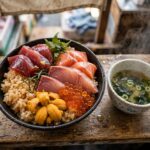
If the counter feels like too much ceremony for a first bite, the kaisendon does the same job in a bowl. Warm seasoned rice, piled high with raw seafood — maguro, salmon, yellowtail, salmon roe, and if the day is kind, sea urchin — in roughly the same price range. It is the honest person’s market breakfast: every important flavor of the morning in one vessel, eaten in about four minutes standing at the shop’s counter. The shops set deeper in the lanes tend to charge less than the ones at the market’s edges for the same fish. Walk two minutes further. You will be rewarded.
And then there is the miso. At the old inner-market bars, the bowl that came with the sashimi was miso soup with clams — small, briny, perfect — and the outer market still does its version everywhere. Hot soup beside cold fish is the whole rhythm of a market morning: the chill of raw tuna, the steam of the broth, back and forth. It wakes up your palate the way cold water wakes up your face.
The Egg Worth Waking Up For
Every market has its mascot, and Tsukiji’s is an omelette. Tamagoyaki — the thick, layered Japanese rolled omelette — is the market’s signature snack, cooked in giant rectangular pans and folded layer over layer with a rhythm so practiced it looks like sleight of hand. The stalls sell it hot on a stick for a couple hundred yen, and there are loyalties. Yamachou’s version leans sweet, almost dessert-like with a caramelized edge. Shouro’s runs savory, heavy on the dashi. Marutake splits the difference. Stand and watch a cook build one before you order; the watching is half the meal.
The move most regulars swear by is the tamagoyaki sando — the warm egg tucked into soft white bread with a smear of Japanese mayonnaise. It sounds absurd and tastes like proof that breakfast sandwiches were invented in the wrong country. It is also, pound for pound, one of the cheapest things in the market, which makes it the ideal first bite: something warm and gentle to hold you while you scout the rest of the lanes.
Everything on a Stick
The lanes run on charcoal. Fat Hokkaido scallops grilled in their shells with butter and soy until the edges caramelize. Squid skewers. Eel brushed with sweet sauce and charred at the tips. Cups of fresh uni and ikura to eat with a tiny spoon, standing at the stall. It is point-and-eat dining at its purest, and the best stalls are the ones with the longest local queues — at Tsukiji, the Japanese regulars are the review section.
Two names worth knowing. Kakigoya is the spot for shellfish: oysters steamed open, plump and briny, beside those scallops. If you have opinions about raw oysters — and Gulf Coast people usually do — this is the place to calibrate them. The cold northern water makes a different oyster than the warm Gulf does, leaner and cleaner-tasting, and trying the two side by side across an ocean is one of the finer seafood educations a person can get. We’ve written about our own raw-oyster season back home in Louisiana, when the Gulf does its cold-water best; this is the Japanese chapter of the same story.
Kitsuneya is the other essential stop: a tiny shop serving horumon-don, a rice bowl topped with beef offal simmered in sweet miso with leeks. It was market-workers’ fuel long before it was a destination — the name comes from an Osaka word for “things to throw away,” because butchers once discarded these cuts. Tsukiji’s workers turned scraps into a legend. There are three cramped seats at the hotpot and standing tables out front; take the standing tables.
How to Do a Market Morning
The outer market runs on trade time. Wholesale buying happens from six to nine, retail sales run roughly nine to two, and most stalls start closing up by early afternoon. Arrive mid-morning, not crack of dawn — the dawn belongs to Toyosu now — and do not arrive past one. The market is closed Sundays, most national holidays, some Wednesdays, and over the New Year period, so check the calendar before you plan around it.
Bring cash, and more of it than you think; plenty of stalls are cash-only. Do not eat while walking the lanes — in Japan it is considered rude, and the stalls expect you to finish your skewer or bowl at their counter before moving on. Hand your rubbish back to the stall. And pace yourself. The single biggest mistake at Tsukiji is filling up at the first three stalls that impress you and missing the best things deeper in the market. Eat small, keep moving, go back for seconds only if something truly demands it. Save room. The lanes reward the hungry and punish the hasty.
What strikes you, standing there with a cup of uni at eight in the morning, is how democratic the whole thing is. The fish at Tsukiji is some of the finest on the planet, and there is no dress code, no reservation, no ceremony — just a line of ordinary people eating extraordinary seafood out of paper cups and lacquer bowls. That is the same instinct that built the great American seafood buffet: take the ocean’s best argument and put it within everyone’s reach. Tokyo just serves its version at dawn, on a stick, in a market that has been perfecting the formula since before your grandparents were born. The inner market moved across the bay. The breakfast stayed exactly where it was.



1 thought on “Breakfast at Tsukiji: Eating at Tokyo’s Fish Market”