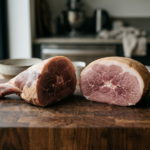
The short answer: yes, chicken at 145°F can be safe — but only under very specific conditions that most home cooks don’t follow.
That’s the part most articles leave out, and it’s exactly what makes this question tricky. The USDA has long recommended cooking chicken to an internal temp of 165°F. That number is drilled into our heads. So when someone tells you chicken breast at 145 is perfectly fine, it’s natural to feel uneasy.
Here’s the thing. The 165°F guideline is designed as an instant-kill temperature — meaning the moment chicken hits 165°F internally, virtually all harmful bacteria (mainly Salmonella) are destroyed immediately. No waiting required. That’s why it’s the standard recommendation. It’s simple, foolproof, and safe for everyone.
But food safety isn’t just about temperature. It’s about temperature plus time. And that’s where 145°F enters the conversation.
Let’s break this down properly so you can make an informed decision the next time you’re grilling, smoking, or roasting chicken.
How Bacteria Are Actually Killed in Meat
Most people think of food safety as a single number: hit the right temperature, and you’re good. That’s partially true, but the actual mechanism is more nuanced.
Bacteria like Salmonella don’t just die the instant they get warm. They die when exposed to a lethal temperature for a certain duration. The higher the temperature, the less time it takes. At 165°F, the kill is essentially instant — less than one second. That’s why the USDA chose it as the easy-to-remember guideline.
At lower temperatures, bacteria still die. It just takes longer.
At 145°F, Salmonella in chicken can be eliminated — but the chicken needs to hold at that temperature for approximately 8.4 minutes according to USDA pasteurization tables. At 150°F, the hold time drops to around 2.8 minutes. At 155°F, it’s about 50 seconds.
This is the same science used in sous vide cooking, where chicken is routinely cooked at temperatures well below 165°F for extended periods. Professional kitchens and food scientists rely on these time-temperature combinations regularly.
So is 145 safe for chicken? Scientifically, yes — if the meat stays at 145°F for long enough.
The real question is whether that’s practical for the way you’re cooking at home.
Why the USDA Still Recommends 165°F
If lower temperatures work with enough hold time, why doesn’t the USDA just tell people that?
A few reasons.
Simplicity matters for public health. Telling millions of home cooks “pull your chicken at 145°F but make sure it holds there for 8.4 minutes using a calibrated thermometer” introduces too much room for error. People might misread their thermometer, pull the chicken early, or not understand that the hold time is critical. The 165°F rule eliminates those variables. One number. No guesswork.
Not everyone has a reliable thermometer. A lot of people still judge doneness by look, feel, or guesswork. The 165°F target provides a wider safety margin.
Certain populations face higher risk. For young children, elderly adults, pregnant women, and immunocompromised individuals, there’s less room for error. The 165°F guideline protects the most vulnerable.
Carryover cooking is unpredictable. When you take chicken off heat, the internal temperature continues to rise — but how much depends on the thickness, cooking method, and resting conditions. Relying on carryover to maintain 145°F for the required hold time adds uncertainty.
The 165°F recommendation isn’t wrong or overly cautious in a meaningless way. It’s a public health tool designed for the broadest possible audience.
Chicken 145 vs 165: What’s the Real Difference?
Beyond safety, there’s a massive difference in texture and juiciness between chicken done at 145 and chicken pulled at 165.
Chicken breast at 145°F (properly held) is noticeably more moist and tender. The proteins haven’t squeezed out as much moisture, so the meat feels almost silky compared to what most people are used to. If you’ve ever had sous vide chicken breast and thought “this doesn’t even taste like the chicken I make at home,” this is why.
At 165°F, especially if overshot by even 5–10 degrees (which happens often), chicken breast loses significantly more moisture. The muscle fibers tighten, and you get that drier, chalkier texture that makes people reach for extra sauce.
Here’s a quick comparison:
| Factor | 145°F (with hold time) | 165°F (instant) |
|---|---|---|
| Safety | Safe if held for ~8.4 minutes | Safe immediately |
| Texture | Juicy, tender, slightly translucent | Firmer, drier, fully opaque |
| Ease of execution | Requires precise thermometer and timing | Simple one-number check |
| Best suited for | Sous vide, experienced cooks with good thermometers | Home cooks, quick grilling, food service |
| Risk if done wrong | Higher — undercooking can leave bacteria alive | Lower — built-in safety margin |
One important detail: chicken cooked to 145°F and properly pasteurized may still look slightly pink near the bone or in thicker sections. This doesn’t mean it’s raw. The color of cooked chicken is influenced by pH, myoglobin levels, and cooking method — not just doneness. But it can be unnerving if you’re not expecting it.
When Cooking Chicken to 145°F Makes Sense
There are situations where targeting a chicken internal temp of 145°F (with proper hold time) is both practical and worthwhile.
Sous vide cooking is the most common and arguably the safest way to do this. You set your water bath to 145°F (or slightly higher), seal the chicken, and cook it for 1–4 hours. The extended cook time ensures pasteurization happens thoroughly — not just at the surface, but all the way through. This is where the science really shines, because you have precise temperature control and plenty of time.
Smoking chicken is another scenario where lower finishing temperatures sometimes come up. If you’re using a pellet grill or smoker at a low and slow temperature, the chicken spends a long time in the cooking zone. That extended exposure can help with pasteurization at slightly lower final temps, though you need to be more careful with timing.
Experienced cooks with instant-read thermometers who understand carryover cooking can sometimes pull chicken off the grill at around 155–157°F, knowing it’ll coast up to 162–165°F while resting. That’s not quite the same as serving chicken at 145°F, but it’s related to the same principle of understanding temperature dynamics rather than blindly chasing a number.
When You Should Absolutely Stick to 165°F
For most everyday home cooking situations, 165°F remains the better target. Not because the science of pasteurization is wrong, but because the conditions usually aren’t controlled enough to guarantee safety at lower temps.
Stick with 165°F when:
- You’re cooking for children, elderly family members, or anyone with a weakened immune system.
- You don’t have a reliable, calibrated instant-read thermometer.
- You’re cooking chicken pieces quickly over high heat (grilling, pan-searing, roasting at high temps) where the meat passes through 145°F rapidly without holding there.
- You’re preparing food for a group or event where you can’t monitor each piece carefully.
- You’re working with ground chicken, which has bacteria distributed throughout the meat, not just on the surface.
Quick Fact: Ground chicken and ground turkey should always reach 165°F regardless of hold time, because grinding distributes surface bacteria throughout the meat. This is different from whole muscle cuts like breasts and thighs.
Speaking of ground poultry, the same principle applies to turkey burgers — always cook them to the full 165°F.
The Role of a Good Meat Thermometer
This entire conversation is pointless without a reliable thermometer. Seriously.
If you’re debating whether chicken is done at 145 or 165, you need to actually know what temperature your chicken has reached. Cutting into the meat and looking at the color is not reliable. Pink chicken can be fully safe, and white chicken can technically be undercooked in the center.
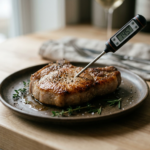
A quality instant-read thermometer (something like a ThermoWorks Thermapen or even a decent $15–20 digital model) gives you a reading in 2–3 seconds. Insert it into the thickest part of the breast or thigh, avoiding bone, and you’ll have your answer.
If you’re not sure how to read a meat thermometer properly, it’s worth spending a few minutes learning. It genuinely changes how you cook — not just chicken, but everything from steak to pork chops to brisket.
What About Chicken Thighs?
Most of the 145°F conversation centers on chicken breasts, because breasts are lean and dry out easily. Thighs are a different story.
Dark meat (thighs, drumsticks) contains more connective tissue and fat. Even though thighs are technically safe at a lower temperature, they don’t taste good until they reach around 175–190°F. At that range, the collagen breaks down into gelatin, giving thighs their rich, tender texture.
So while you could eat a chicken thigh at 145°F (with proper hold time), you probably wouldn’t enjoy it. The texture would be rubbery and chewy. For thighs, the ideal done temperature is well above 165°F — usually around 180–190°F.
The 145 vs 165 debate really only matters for breast meat, where overcooking has the biggest negative impact on eating quality.
A Practical Approach for Home Cooks
If you’ve read this far, here’s a sensible takeaway that balances safety and quality.
For grilling, roasting, and pan-cooking chicken breasts: Pull the chicken off heat when the internal temp hits 157–160°F. Tent it loosely with foil and let it rest for 5 minutes. Carryover heat will bring it to 163–167°F, which is right in the safe zone. The chicken will be noticeably juicier than if you’d cooked it straight to 165°F on the heat source, because those last few degrees happen gently during rest.
This approach gives you the safety of 165°F without the dryness of overshooting it on the grill. You’re working with the physics of cooking rather than against them.
For sous vide: Set your bath to 145–150°F and cook boneless chicken breasts for at least 1.5 hours (for breasts about 1 inch thick — thicker pieces need longer). The extended cook time guarantees pasteurization. This method produces the juiciest results by far.
For smoking: If you’re using a Traeger or similar pellet smoker at 225–275°F, the chicken moves through the danger zone slowly enough that you should still target 165°F at the thickest point to be safe. Low-and-slow smoking doesn’t guarantee the same hold time at a specific temperature that sous vide does.
FAQ
Is it legal for restaurants to serve chicken at 145°F?
In the United States, food codes in many jurisdictions allow restaurants to serve chicken below 165°F if they can demonstrate that the time-temperature combination achieves equivalent pasteurization. This is sometimes called a “HACCP plan variance.” Some high-end restaurants routinely serve sous vide chicken cooked to 145–150°F under these protocols. Standard restaurants typically follow the 165°F rule for simplicity and liability reasons.
Can you tell if chicken is safe just by looking at it?
No. Color is not a reliable indicator of doneness or safety. Chicken can appear pink and be fully pasteurized, or look white and still be undercooked in spots. The only reliable method is checking the internal temperature with a thermometer.
Does brining or marinating chicken affect safe cooking temperature?
Brining and marinating don’t change the temperature needed to kill bacteria. They do affect moisture retention, which means brined chicken cooked to 165°F will taste juicier than unbrined chicken at the same temp. If your main concern is dry chicken, brining for 1–2 hours before cooking is a simpler solution than trying to cook to a lower temperature.
Is chicken safe at 145 if it’s only at that temp for a second?
No. At 145°F, chicken needs to hold at that temperature for about 8.4 minutes to achieve the same level of pathogen reduction as hitting 165°F instantly. If the chicken passes through 145°F on its way to a higher temp, that brief moment at 145 does not make it safe on its own.
What about the 2024 USDA update on poultry temperatures?
As of early 2024, the USDA has acknowledged that lower temperatures with appropriate hold times can safely cook poultry, but their official consumer-facing recommendation remains 165°F for home cooking. Any changes to official guidelines would be noted on the USDA’s Food Safety and Inspection Service website.
The Bottom Line
Is 145 safe for chicken? The science says yes — with a big asterisk. That asterisk is hold time, and it matters enormously.
If you’re doing sous vide and can precisely control both temperature and duration, cooking chicken to 145°F is well within safe territory. If you’re grilling chicken breasts on a Saturday afternoon, aiming for 157–160°F off the heat and resting to 165°F gives you the best balance of safety and juiciness.
The one thing that ties all of this together is a good thermometer. Without one, you’re guessing — and guessing with chicken isn’t worth the risk. Grab a reliable instant-read, learn how to use it properly, and you’ll cook better chicken every single time, regardless of what final number you’re targeting.