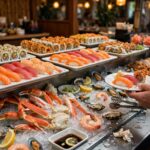
Stand in front of a sushi buffet line and you’ll see three kinds of pieces staring back at you, and they are not interchangeable. A slice of sashimi, a piece of nigiri, and a cut of maki might all contain the same salmon, but they cost the kitchen — and you, in appetite and value — very different amounts. Once you understand what goes into each one, the whole line starts to make sense, and you start choosing with a plan instead of a pile.
It starts with the rice. Sushi, by definition, is vinegared rice. That’s the line in the sand. Anything built on that seasoned short-grain rice counts as sushi; anything served without it doesn’t, no matter how much fish is involved. That one distinction explains most of the confusion on the menu board, and most of the price difference on the line.
Sashimi: Nothing but the Fish
Sashimi is the purest and the most expensive thing on the line, and there’s no mystery why. It’s a thinly sliced piece of raw fish or seafood, served with nothing underneath it — no rice, no roll, no sauce doing the heavy lifting. What you taste is the fish itself, and what the kitchen spends is almost entirely the fish itself.
That purity is also why sashimi is unforgiving. With no rice to soften a mediocre cut and no roll to hide behind, the quality has to be top grade, and the knife work has to be exact. A good slice is cut against the grain at a thickness that lets the fish’s texture come through — too thick and it fights you, too thin and it falls apart. The classic garnishes, shredded daikon and a shiso leaf, are there to cleanse the palate, not to decorate the plate.
For you, the diner, sashimi is the best value on a buffet line precisely because it carries no filler. Every bite is the ingredient you’d pay the most for anywhere else. It’s also the least filling piece on the line, which matters more than people think — a plate of sashimi leaves room for the rest of the meal in a way a plate of rolls never will. The trade-off is that it asks something of you: if you’re new to raw fish, sashimi is the boldest first step, because there’s nothing between you and the flavor.
Nigiri: The Chef’s Handshake
Nigiri is where the fish meets the rice, and where the chef’s skill shows up most clearly. A small mound of vinegared rice — called shari — is pressed by hand into an oval, dabbed with a whisper of wasabi, and topped with a single slice of fish, the neta. It’s usually served two pieces to an order, and it’s meant to be eaten in one bite.
That hand-pressing matters more than it sounds. The rice should hold together just long enough to reach your mouth and then give way; too tight and it turns into a dense lump, too loose and it crumbles on the chopsticks. Done right, the warmth of the rice against the cool fish is one of the quiet pleasures of sushi, and the seasoned rice — vinegar, sugar, and salt in balance — softens the intensity of the raw fish without burying it.
On the cost side, nigiri sits in the middle. The fish is the same quality as sashimi, but there’s less of it per piece, and the rice stretches it further. For the diner, that makes nigiri the friendliest way to taste premium fish: you get the clean flavor of the salmon or tuna or yellowtail, tempered by the rice, at a fraction of the appetite a sashimi plate demands. If you’re still learning what you like, nigiri is the honest middle ground — real fish flavor, with a safety net.
One piece of etiquette worth knowing: nigiri is traditionally eaten fish-side down in the soy sauce, just a light dip. Drowning the rice soaks it and breaks the piece apart, and it floods the delicate balance the chef built. A little restraint goes a long way.
Maki: The Roll That Carries Everything
Maki is the roll, and it’s the piece most people picture when they hear the word sushi. Rice and fillings are spread on a sheet of nori, rolled up on a bamboo mat, and sliced into bite-sized rounds. Thin hosomaki rolls carry a single filling, like cucumber or tuna; thick futomaki rolls pack several; and uramaki, the inside-out roll, puts the rice on the outside, which is how the California roll — invented for American diners wary of seaweed — became a staple.
Maki is where creativity lives. A roll can carry cooked shrimp, vegetables, spicy tuna, avocado, crunchy tempura bits, and sauces all at once, which is why it’s the easiest entry point for beginners and the most forgiving format for a kitchen. It’s also, frankly, the cheapest piece on the line to produce. The fish is a smaller share of each bite, the rice and nori do most of the work, and one roll yields six to eight pieces from a modest amount of filling.
That doesn’t make maki a bad choice — far from it. A well-made roll is a complete little composition, and some combinations genuinely don’t work any other way. But it does mean maki fills you up fastest for the least fish. If your goal is to taste the best of the line, a plate stacked with rolls is the quickest way to get full before you’ve had any of it. Save the rolls for the flavors you can’t get any other way, and let the fish-led pieces do the rest.
Reading the Line Like a Regular
Put it together and the line reads like a budget. Sashimi spends the most on fish and gives you the most fish back; nigiri splits the difference, fish on a small bed of rice, shaped by hand; maki spreads a little fish across a lot of rice and seaweed and delivers variety instead of intensity. None of that is a judgment — a good meal usually has all three. The mistake is treating them as equals and loading up on the one that fills you fastest.
A sensible order, if you’re building a plate, starts with a few pieces of sashimi to taste the fish at its best, moves to nigiri for the balance of fish and rice, and finishes with a roll or two for the combinations and crunch you can’t get elsewhere. You’ll leave having actually tasted the line instead of just filling up on it, and you’ll understand why the same salmon can cost the kitchen three different amounts depending on how it’s cut, pressed, or rolled.
And that, really, is the whole game. Sushi isn’t one food with three names. It’s three different ideas about what to do with a piece of fish — serve it bare, balance it on rice, or roll it into something bigger — and knowing which idea you’re eating is what turns a buffet line from a guessing game into a good dinner. If you want to go deeper on the foundation underneath all of it, our piece on why rice matters is the natural next read.


1 thought on “Nigiri vs Sashimi vs Maki: What Each Costs You on the Line”