The single most common reason meatloaf turns out dry, crumbly, or — worse — undercooked in the center has nothing to do with the recipe. It’s because people rely on oven time instead of checking the meatloaf internal temperature.
A meatloaf made with ground beef, pork, veal, or any combination of those needs to reach 160°F (71°C) at the thickest part of the loaf. If you’re making a turkey or chicken meatloaf, the target is 165°F (74°C). Those are the safe meatloaf temperatures set by the USDA, and they’re non-negotiable when it comes to ground meat.
That’s your quick answer. But sticking a thermometer in and pulling the loaf out at exactly the right moment involves a few details worth understanding — especially if you want a meatloaf that’s both safe and juicy rather than one that’s safe and resembles a brick.
Why Meatloaf Temperature Matters More Than Cooking Time
Most meatloaf recipes say something like “bake at 350°F for about an hour.” That’s a rough guideline, and it can work. But the actual time your meatloaf needs depends on a lot of variables:
- The size and shape of the loaf (a flat, wide loaf cooks much faster than a tall, compact one)
- Whether you’re baking it in a loaf pan or free-form on a sheet pan
- Your oven’s actual temperature versus what the dial says
- How cold the meat mixture was when it went in
- How much moisture is in the mix (eggs, breadcrumbs, milk, vegetables)
A two-pound meatloaf made in a deep loaf pan could take 75 minutes. The same mixture shaped into a flatter dome on a baking sheet might be done in 50. Relying on the clock alone means you’re gambling.
Ground meat is different from whole cuts like steaks or roasts. With a steak, bacteria sit on the surface and get killed by searing. With ground meat, any bacteria present on the surface of the original cut get mixed throughout during grinding. That’s exactly why the meatloaf done temperature needs to be reached all the way through — not just near the edges.
If you’re curious about how internal temperatures work for other ground meat dishes, the hamburger internal temperature guide covers the same principle for burgers.
The Right Internal Temp for Meatloaf, by Meat Type
Not all meatloaf is made from the same protein, and the target temperature shifts depending on what’s in yours.
| Meat Type | Safe Internal Temp | Notes |
|---|---|---|
| Beef meatloaf | 160°F (71°C) | Applies to all ground beef, including ground sirloin blends |
| Pork meatloaf | 160°F (71°C) | Same target as beef |
| Beef-pork-veal mix (classic) | 160°F (71°C) | Go by the highest required temp in the blend |
| Turkey meatloaf | 165°F (74°C) | Ground poultry always needs to go higher |
| Chicken meatloaf | 165°F (74°C) | Same as turkey |
One thing people sometimes get confused about: pork chops and pork tenderloin can safely be eaten at 145°F per USDA guidelines. But that rule applies to whole cuts, not ground pork. If your meatloaf contains ground pork, you still need 160°F. The pork chop internal temp page explains that distinction clearly.
How to Check Meatloaf Temperature Accurately
Sticking a thermometer into a meatloaf sounds simple enough, but there’s a right way and a wrong way.
Insert the probe into the geometric center of the loaf — the thickest part. Push it in far enough that the tip sits in the middle of the meatloaf, not near the bottom of the pan or close to the top surface. Both of those spots will read hotter than the true center because they’re closer to the heat source or the oven air.
If you’re using a loaf pan, insert from the top and angle the probe so it reaches the center of the densest section. If the loaf is free-form on a sheet pan, go straight in from the side.
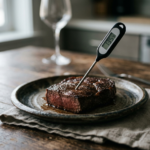
An instant-read digital thermometer is the best tool here. The cheap dial-type thermometers that come with some ovens can be off by 10°F or more, and they’re slow enough that you end up holding the oven door open for a while, which drops the oven temperature. A good digital instant-read gives you a reading in 2–3 seconds.
A leave-in probe thermometer is even better if you have one. You set the target temperature, and it alerts you when the meatloaf hits it. No opening the oven to check, no guessing. This is the same approach that works well for smoking brisket or roasting a large cut. If you haven’t used a probe thermometer before, the how to read a meat thermometer guide walks through different thermometer types.
Quick Fact: Take the reading from at least two different spots in the loaf. Meatloaf doesn’t always cook evenly, especially in a loaf pan where the corners heat up faster than the center.
Carryover Cooking: Pull It a Few Degrees Early
This is the detail that separates a good meatloaf from a great one.
Meatloaf continues to cook after you take it out of the oven. The outer layers are hotter than the center, and that residual heat pushes inward. For a standard-sized meatloaf, the internal temp can rise another 3 to 5 degrees during the resting period.
So if you’re making a beef meatloaf and you want it to land at exactly 160°F, pulling it out at 155–157°F and letting it rest for 10 minutes gets you there. The loaf finishes cooking gently, and you avoid pushing past 160°F into dry territory.
For turkey or chicken meatloaf, pull at 160–162°F and let carryover bring it to 165°F.
Resting also lets the juices redistribute. If you cut into a meatloaf the moment it comes out of the oven, liquid pools out onto the cutting board and you’re left with drier slices. Ten minutes of resting under a loose tent of foil makes a noticeable difference.
This same carryover principle applies to virtually every large piece of meat you cook. It’s one of the reasons knowing what temperature brisket is done matters so much — pull too late and carryover pushes it past ideal.
What Happens If You Undercook or Overcook
Undercooking ground meat is a genuine food safety risk. Ground beef, pork, or poultry can harbor Salmonella, E. coli, and other pathogens throughout the meat — not just on the surface. An undercooked center means those bacteria survive. There’s no reliable way to tell whether ground meat is safe by color alone (more on that below).
Overcooking won’t make you sick, but it does make for a dry, tough, crumbly meatloaf that nobody wants seconds of. Every degree past 160°F (or 165°F for poultry) squeezes more moisture out of the proteins. By the time a beef meatloaf hits 180°F internally, it’s significantly drier than one pulled at 160°F.
The sweet spot is narrow, which is exactly why a thermometer matters so much. You’re aiming for a window of roughly 5 degrees, and you can’t eyeball that.
Can You Tell Meatloaf Is Done Without a Thermometer?
Technically, people have been making meatloaf without thermometers for decades. But the old methods aren’t reliable.
The color test is the most common one — if the inside isn’t pink, it’s done. The USDA has specifically warned against this. Ground beef can turn brown before it reaches a safe temperature, and it can remain slightly pink even after passing 160°F. Pink color in cooked ground meat is sometimes caused by myoglobin reactions, certain vegetables in the mix (like onions), or the pH of the meat. It doesn’t always indicate doneness.
The “poke it with a knife and check the juices” method is equally unreliable. Clear juices generally correlate with doneness, but not always. A meatloaf loaded with tomato-based glaze can have juices that look pinkish even when fully cooked.
The “shrinking away from the pan” method tells you the outside is well-done, but says nothing about the center.
A thermometer costs as little as $10–15 and removes all guesswork. If you cook meat of any kind with any regularity, it’s one of the most useful tools you can own.
Best Oven Temperature for Cooking Meatloaf
The meatloaf cooking temperature — meaning the oven setting — affects how evenly the loaf cooks and how the exterior develops.
350°F is the standard, and it works well for most meatloaves. It gives the center enough time to cook through without the outside drying out or the glaze burning.
375°F works if your meatloaf is on the smaller side (under 1.5 pounds) or if you prefer a slightly more caramelized exterior. Keep an eye on the glaze — sugar-based glazes can scorch above 375°F.
325°F is useful for larger loaves (2.5+ pounds). The lower temperature lets heat penetrate the center more gradually, reducing the risk of a dried-out exterior with a raw center.
Going above 400°F for meatloaf is rarely a good idea. The outside overcooks long before the center reaches a safe meatloaf temperature, and you end up with a loaf that’s burnt on the outside and questionable in the middle.
A free-form meatloaf on a sheet pan cooks faster than one packed into a loaf pan at the same oven temperature, because more surface area is exposed to heat. Adjust your timing accordingly, and start checking the internal temp for meatloaf about 15 minutes before you think it’ll be done.
Loaf Pan vs. Free-Form: How Shape Affects Doneness
This comes up less often than it should, because the shape of your meatloaf directly impacts cook time and texture.
Loaf pan: The sides of the pan insulate the meat somewhat, meaning slower heat penetration. The loaf also sits in its own rendered fat and juices, which can make the bottom soggy if you’re not careful. Some cooks place the meatloaf on a small rack inside the pan, or shape it in the pan and then invert it onto a sheet pan before baking. A loaf pan meatloaf at 350°F typically takes 55–75 minutes for a 2-pound loaf, depending on ingredients and oven accuracy.
Free-form on a sheet pan: More surface area is exposed, so the exterior develops a better crust and any glaze caramelizes more evenly. The loaf cooks faster — often 10–15 minutes quicker than a loaf pan version of the same size. Drippings run off instead of pooling, so the bottom stays firmer. The trade-off is that free-form loaves can spread and flatten if the mixture is too wet.
In a muffin tin: Individual portions cook in about 25–30 minutes. The meatloaf temp still needs to hit the same target, but there’s less temperature variation between edge and center because the portions are small. This works well for meal prep.
Common Meatloaf Mistakes That Affect Temperature and Texture
A few pitfalls trip people up regularly:
- Mixing the meat too aggressively. Overworking ground meat develops the proteins (similar to kneading bread dough), making the final loaf dense and tough. Mix until the ingredients are just incorporated.
- Skipping the panade. That mixture of milk and breadcrumbs (or crackers, or even oats) isn’t filler — it’s what keeps the meatloaf moist and tender. Without it, the loaf compacts as it cooks and dries out before it even reaches the done temperature.
- Cold ingredients from the fridge. If the egg, milk, and meat are all ice-cold, the center of the loaf takes significantly longer to cook through. Letting ingredients sit at room temperature for 15–20 minutes before mixing can improve cook-time consistency.
- Not calibrating your oven. Oven thermostats drift over time. An oven set to 350°F might actually be running at 325°F or 375°F. An inexpensive oven thermometer (different from a meat thermometer) can tell you what’s really going on in there.
- Adding the glaze too early. If you put a sugary glaze on at the start of cooking, it can burn before the meatloaf finishes. Apply the glaze during the last 15–20 minutes of cooking for the best results.
A Word About Turkey and Chicken Meatloaf
Turkey and chicken meatloaf have a reputation for drying out, and there’s a reason: poultry needs to hit 165°F, which is 5 degrees higher than beef or pork, and ground poultry is naturally leaner. That combination means less margin for error.
A few things that help:
Use ground thigh meat instead of breast meat. Thigh has more fat, which translates to more moisture and flavor. If your store only carries generic “ground turkey,” it’s usually a mix of breast and thigh, which is fine.
Add more binder. An extra splash of milk in the panade, or even a tablespoon of mayo mixed into the meat, adds fat and moisture that helps the loaf stay tender at the higher meatloaf internal temp.
Don’t skip the resting period. Carryover cooking is even more important here, because every degree above 165°F makes lean poultry meatloaf noticeably drier.
If you’re interested in safe temperatures for other poultry cuts, the chicken thighs done temp page is worth a look.
Storing and Reheating Leftover Meatloaf
Cooked meatloaf keeps in the fridge for 3 to 4 days when stored in an airtight container. In the freezer, it lasts 2 to 3 months without significant quality loss.
When reheating, bring the internal temp back to at least 165°F regardless of the original meat type. This is the USDA’s safe reheating temperature for all leftovers.
The microwave works but tends to dry out the edges. A better approach: cover slices loosely with foil and reheat in a 325°F oven for about 15–20 minutes. Adding a tablespoon of broth or water under the foil creates a bit of steam that keeps things moist.
Leftover meatloaf slices also make excellent sandwiches when served cold or lightly pan-fried — something that gets overlooked but is genuinely good.
FAQ
What temp is meatloaf done if it’s made with a mix of beef and pork?
160°F (71°C). Both beef and pork require the same meatloaf done temperature when ground. A mixed-meat loaf follows the same rule.
Is meatloaf safe to eat if it’s slightly pink inside?
It can be, as long as the internal temp for meatloaf reads 160°F (beef/pork) or 165°F (poultry). Ground meat can remain pink due to certain chemical reactions even when fully cooked. Color is not a reliable indicator of safety — temperature is.
How long should meatloaf rest before cutting?
About 10 minutes. This lets the internal temperature finish rising through carryover cooking and allows juices to redistribute. Loosely tent with foil to keep it warm without trapping too much steam (which can soften a crisp glaze).
Can I cook meatloaf at a higher temperature to speed things up?
You can go up to 375°F without major issues, but higher than that creates a big temperature gap between the outside and center. The edges overcook while the interior stays underdone. A moderate oven temperature with a thermometer check gives better results than cranking the heat.
Do I need a special thermometer for meatloaf?
No. Any instant-read digital meat thermometer works. You don’t need a fancy model — even a basic $12 digital thermometer is far more accurate and useful than guessing. If you’d like guidance on types, the how to read a meat thermometer article covers your options.
The bottom line is straightforward: 160°F for beef and pork meatloaf, 165°F for turkey or chicken, measured at the center with a thermometer. Pull it a few degrees early, let it rest, and you’ll have a meatloaf that’s both safe and actually worth eating. No guessing, no cutting it open to check, no dry edges. Just a thermometer and about ten seconds of patience.